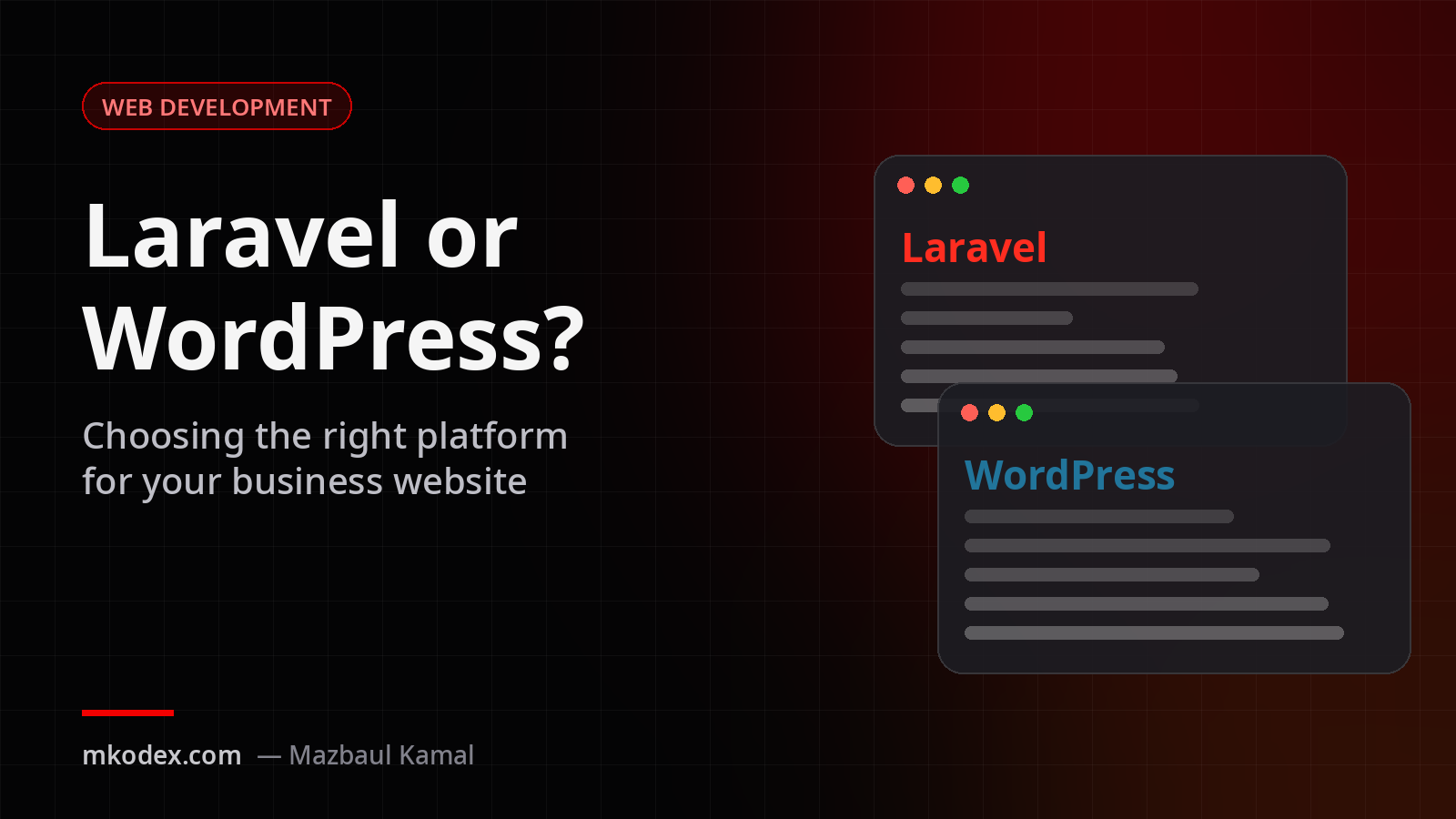
One of the first questions I get from clients is: should we build on WordPress or Laravel? Both are excellent, and I build with both every week. But they are different kinds of tools, and picking the wrong one usually shows up later as higher costs or a site that is hard to grow.
Here is the simple way I explain the difference.
WordPress: a ready-made house you can furnish
WordPress is a content management system. Out of the box you get pages, posts, media, users and a huge library of themes and plugins. For many businesses that is exactly what they need.
WordPress is a great fit when:
- Your site is mostly content: pages, a blog, a portfolio, a contact form.
- Your team wants to edit text and images without a developer.
- You need a standard feature that a trusted plugin already does well, such as SEO tools or a simple shop with WooCommerce.
- You want to launch quickly on a moderate budget.
Laravel: a custom building designed around you
Laravel is a PHP framework, not a ready-made CMS. Everything is built for your exact workflow: the database, the admin panel, the user roles, the business rules. It takes more work up front, and it gives you full control.
Laravel is the better choice when:
- Your website is really an application: bookings, customer portals, dashboards, multi-step forms or internal tools.
- You have business logic that plugins cannot express cleanly.
- You expect real growth in users or data and want performance you can tune.
- Security and permissions matter, for example different staff roles that see different data.
- You need to connect several systems through APIs: payments, CRMs, ERPs, SMS gateways.
A quick rule of thumb: if most of the work is publishing content, start with WordPress. If most of the work is doing something with data, choose Laravel.
Side by side
- Speed to launch: WordPress is usually faster for content sites; Laravel takes longer because it is built to measure.
- Editing content: WordPress is excellent out of the box; with Laravel you get exactly the admin screens you need, and nothing extra.
- Custom features: WordPress depends on plugins, which can conflict; Laravel handles them as normal code.
- Maintenance: WordPress needs regular core, theme and plugin updates; Laravel needs framework and package updates, with fewer moving parts from third parties.
- Scaling: both can scale, but Laravel gives you more control over caching, queues and database design.
The hybrid option
You do not always have to choose one. A common setup is a WordPress marketing site for pages and blog posts, with a Laravel application behind a login for customers or staff. Each tool does what it is best at.
Questions to ask before you decide
- What will people actually do on the site, beyond reading it?
- Who will update the content, and how often?
- Which other systems must it connect to?
- Where do you want the project to be in two years?
Your answers to those four questions usually make the choice obvious.
Key takeaways
- WordPress is ideal for content-led websites that need to launch quickly.
- Laravel is ideal for custom features, complex data and long-term growth.
- The right choice depends on what your users do, not on which tool is more popular.
Not sure which one fits your project? Tell me what you want to build and I will recommend the simplest platform that does the job well.